8. Tree-Shaking with zod/mini & JIT Compilation
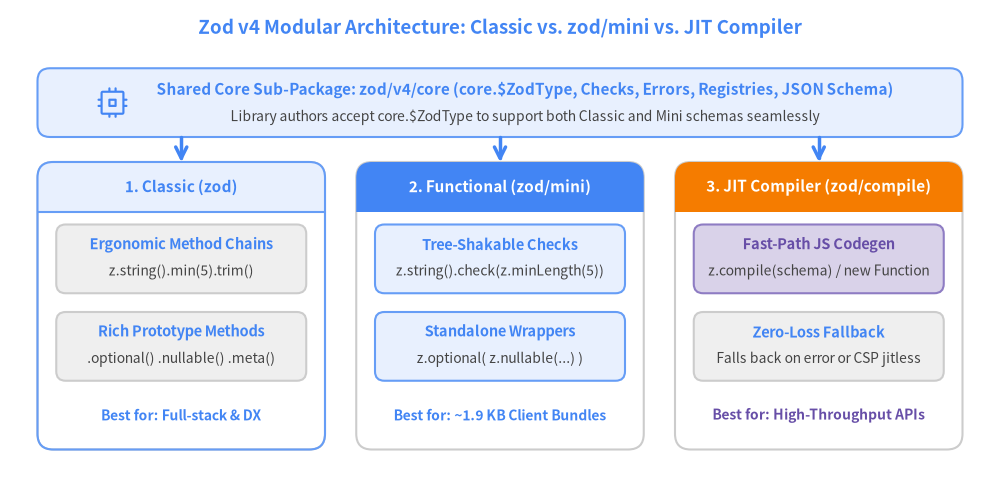
Zod v4 is built on a modular 3-tier architecture (zod/v4/core -> zod Classic / zod/mini + zod/compile). Whether you are shipping a latency-sensitive mobile web bundle that needs a ~1.9 KB gzipped validator via zod/mini, or running a high-throughput Node.js/Bun ingestion service powered by zod/compile JIT code generation, Zod v4 lets you optimize for both bundle size and raw CPU speed without sacrificing type safety.
Source Code
from drawlib.canvas import save, setup
from drawlib.icons import phosphor
from drawlib.lines import line
from drawlib.shapes import rectangle
from drawlib.smartarts import Panel
from drawlib.styles import Colors, Styles
from drawlib.text import text

setup(width=160, height=78)

text(
    (80, 73.5),
    "Zod v4 Modular Architecture: Classic vs. zod/mini vs. JIT Compiler",
    style=Styles.PrimaryBold.patch(text_size=13.5),
)

# Top Foundation Banner: zod/v4/core
rectangle((80, 61.5), width=148, height=11, style=Styles.PrimaryNeutral.patch(shape_r=2.0))
phosphor.cpu((18, 61.5), width=5.5, style=Styles.Primary)
text(
    (84, 63.5),
    "Shared Core Sub-Package: zod/v4/core (core.$ZodType, Checks, Errors, Registries, JSON Schema)",
    style=Styles.PrimaryBold.patch(text_size=11.0),
)
text(
    (84, 59.2),
    "Library authors accept core.$ZodType to support both Classic and Mini schemas seamlessly",
    style=Styles.Neutral.patch(text_size=10.0),
)

# Column 1: Classic `zod`
Panel(
    "1. Classic (zod)",
    style=Styles.Neutral.patch(shape_fill_color=Colors.White),
    header_style=Styles.PrimaryNeutral,
    text_style=Styles.PrimaryBold.patch(text_size=11.0),
    header_align="center",
).draw((6, 6), width=46, height=46)

rectangle((29, 36.5), width=40, height=11, style=Styles.Neutral.patch(shape_r=1.5))
text((29, 38.8), "Ergonomic Method Chains", style=Styles.PrimaryBold.patch(text_size=10.5))
text((29, 34.5), "z.string().min(5).trim()", style=Styles.Neutral.patch(text_size=10.0))

rectangle((29, 22.5), width=40, height=11, style=Styles.Neutral.patch(shape_r=1.5))
text((29, 24.8), "Rich Prototype Methods", style=Styles.PrimaryBold.patch(text_size=10.5))
text((29, 20.5), ".optional() .nullable() .meta()", style=Styles.Neutral.patch(text_size=10.0))

text((29, 11.5), "Best for: Full-stack & DX", style=Styles.PrimaryBold.patch(text_size=10.0))

# Column 2: Functional `zod/mini`
Panel(
    "2. Functional (zod/mini)",
    style=Styles.Neutral.patch(shape_fill_color=Colors.White),
    header_style=Styles.PrimaryFlat,
    text_style=Styles.WhiteBold.patch(text_size=11.0),
    header_align="center",
).draw((57, 6), width=46, height=46)

rectangle((80, 36.5), width=40, height=11, style=Styles.PrimaryNeutral.patch(shape_r=1.5))
text((80, 38.8), "Tree-Shakable Checks", style=Styles.PrimaryBold.patch(text_size=10.5))
text((80, 34.5), "z.string().check(z.minLength(5))", style=Styles.Neutral.patch(text_size=10.0))

rectangle((80, 22.5), width=40, height=11, style=Styles.PrimaryNeutral.patch(shape_r=1.5))
text((80, 24.8), "Standalone Wrappers", style=Styles.PrimaryBold.patch(text_size=10.5))
text((80, 20.5), "z.optional( z.nullable(...) )", style=Styles.Neutral.patch(text_size=10.0))

text((80, 11.5), "Best for: ~1.9 KB Client Bundles", style=Styles.PrimaryBold.patch(text_size=10.0))

# Column 3: JIT `zod/compile`
Panel(
    "3. JIT Compiler (zod/compile)",
    style=Styles.Neutral.patch(shape_fill_color=Colors.White),
    header_style=Styles.AccentFlat,
    text_style=Styles.WhiteBold.patch(text_size=11.0),
    header_align="center",
).draw((108, 6), width=46, height=46)

rectangle((131, 36.5), width=40, height=11, style=Styles.SecondaryNeutral.patch(shape_r=1.5))
text((131, 38.8), "Fast-Path JS Codegen", style=Styles.SecondaryBold.patch(text_size=10.5))
text((131, 34.5), "z.compile(schema) / new Function", style=Styles.Neutral.patch(text_size=10.0))

rectangle((131, 22.5), width=40, height=11, style=Styles.Neutral.patch(shape_r=1.5))
text((131, 24.8), "Zero-Loss Fallback", style=Styles.PrimaryBold.patch(text_size=10.5))
text((131, 20.5), "Falls back on error or CSP jitless", style=Styles.Neutral.patch(text_size=10.0))

text((131, 11.5), "Best for: High-Throughput APIs", style=Styles.SecondaryBold.patch(text_size=10.0))

# Arrows from Core to 3 columns
line((29, 56), (29, 52), arrow_head="->", style=Styles.PrimaryBold)
line((80, 56), (80, 52), arrow_head="->", style=Styles.PrimaryBold)
line((131, 56), (131, 52), arrow_head="->", style=Styles.PrimaryBold)

save()
1. Why zod/mini Exists (And How It Tree-Shakes)
In classic zod, convenience methods like .min(), .max(), .trim(), .optional(), .nullable(), and .default() are attached to ZodType.prototype or ZodString.prototype. Because JavaScript bundlers (Rollup, Webpack, esbuild, Vite) cannot statically prove which prototype methods are unused across module boundaries, importing z.boolean() in Zod v3 pulled in the entire method table.
zod/mini solves this by stripping prototype wrapper methods down to the bare minimum (parse, safeParse, parseAsync, safeParseAsync, check, clone, register, brand, apply) and exposing all validations, mutations, and wrappers as standalone, tree-shakable functions.
Side-by-Side Comparison: Classic zod vs. zod/mini
| Operation | Classic zod (import * as z from "zod") |
Functional zod/mini (import * as z from "zod/mini") |
|---|---|---|
| String checks | z.string().min(3).max(20) |
z.string().check(z.minLength(3), z.maxLength(20)) |
| String transforms | z.string().trim().toLowerCase() |
z.string().check(z.trim(), z.toLowerCase()) |
| Number bounds | z.number().gte(0).lt(100).multipleOf(5) |
z.number().check(z.gte(0), z.lt(100), z.multipleOf(5)) |
| Set / Map size | z.set(z.string()).min(1).max(10) |
z.set(z.string()).check(z.minSize(1), z.maxSize(10)) |
| Custom refinement | schema.refine((val) => isValid(val)) |
schema.check(z.refine((val) => isValid(val))) |
| In-place mutation | schema.overwrite((val) => val.trim()) |
schema.check(z.overwrite((val) => val.trim())) |
| Optional / Nullable | z.string().optional().nullable() |
z.nullable(z.optional(z.string())) |
| Default / Prefault | z.string().default("guest") |
z._default(z.string(), "guest") / z.prefault(...) |
| Object manipulation | User.pick({ id: true }).partial() |
z.partial(z.pick(User, { id: true })) |
import * as z from "zod/mini";

// Only the exact schemas and checks imported here are included in your client bundle!
const SignupFormSchema = z.object({
  username: z.string().check(
    z.trim(),
    z.minLength(3, { error: "At least 3 characters" }),
    z.maxLength(24),
    z.regex(/^[a-zA-Z0-9_]+$/)
  ),
  email: z.email(),
  age: z.optional(z.number().check(z.int(), z.gte(18))),
  marketingOptIn: z._default(z.boolean(), false),
});

type SignupForm = z.infer<typeof SignupFormSchema>;
// { username: string; email: string; age?: number | undefined; marketingOptIn: boolean }

const result = SignupFormSchema.safeParse({
  username: "  alice_dev  ",
  email: "alice@example.com",
});
// result.data -> { username: "alice_dev", email: "alice@example.com", marketingOptIn: false }
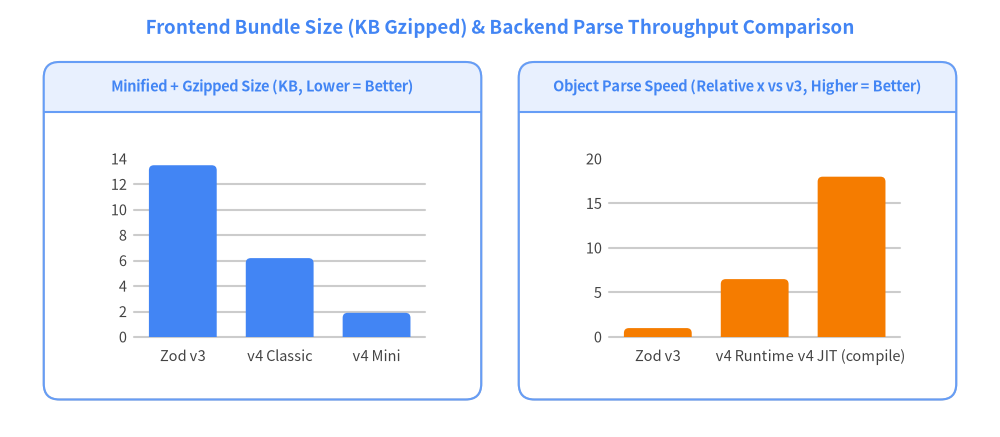
2. Bundle Size & Runtime Throughput Comparison
3. Writing Shared Libraries with zod/v4/core
If you maintain an open-source library, design system, or internal SDK in a monorepo, you should never force your consumers to choose between zod and zod/mini. Both packages inherit from the exact same constructor traits in zod/v4/core.
By typing your generic functions against core.$ZodType and calling top-level functions (core.parse, core.safeParse, core.toJSONSchema), your library works seamlessly with both zod and zod/mini schemas:
import * as core from "zod/v4/core";

// Accepts ANY Zod v4 schema (Classic `ZodType` or Mini `ZodMiniType`)
export function validateEnv<T extends core.$ZodType>(
  schema: T,
  env: Record<string, string | undefined>
): core.output<T> {
  const result = core.safeParse(schema, env);
  if (!result.success) {
    throw new Error(
      `Invalid environment configuration:\n${core.prettifyError(result.error)}`
    );
  }
  return result.data;
}
4. High-Throughput Validation with z.compile() & zod/compile
For CPU-bound backend services (API gateways, message queue consumers, bulk JSONL/CSV ingestion), Zod v4 includes a Just-In-Time (JIT) / Ahead-Of-Time (AOT) schema compiler.
How the Compiler Works Under the Hood
When you compile a schema, Zod traverses its _zod.def AST and generates a specialized JavaScript function (via new Function) that inlines type checks, property lookups, regex tests, and numeric bounds into flat local variables—eliminating interpreter dispatch and closure allocations on the happy path:
- Fast Path on Valid Input: Synchronous forward calls (
schema.parse(data)andschema.safeParse(data)) execute the compiled JavaScript function directly and construct a fresh output value. - Zero-Fidelity-Loss Fallback on Invalid Input: If the compiled function encounters an invalid field, it immediately returns the internal sentinel
Symbol.for("zod.compile.invalid")(z.INVALID) and hands execution back to the standard runtime interpreter. This guarantees that 100% of Zod's error Precedence Maps, issue paths, and localized error messages behave identically to uncompiled schemas! - Automatic Bypass for Async & Backward Paths:
.parseAsync(),.encode(), andskipChecksautomatically bypass the compiled fast path and execute on the runtime interpreter.
Usage Mode A: Explicit Per-Schema Compilation (z.compile())
Use z.compile(schema) to selectively compile hot-path schemas while leaving the original schema untouched:
import * as z from "zod";

const TelemetryEventSchema = z.object({
  eventId: z.uuid(),
  timestamp: z.number().int().positive(),
  service: z.enum(["auth", "billing", "search"]),
  latencyMs: z.number().gte(0).lte(60_000),
  tags: z.array(z.string().min(1).max(32)),
});

// Returns a compiled clone with an optimized `_zod.run` fast path
const FastTelemetrySchema = z.compile(TelemetryEventSchema);

// Same API, same error messages, ~3x faster than already-fast Zod v4 runtime!
const event = FastTelemetrySchema.parse({
  eventId: "550e8400-e29b-41d4-a716-446655440000",
  timestamp: 1735689600000,
  service: "billing",
  latencyMs: 14.2,
  tags: ["prod", "us-east1"],
});
By default, if a schema uses a feature that cannot be compiled (such as async refinements), z.compile(schema) silently returns the original schema so your code never breaks. Pass { strict: true } (z.compile(schema, { strict: true })) during testing if you want Zod to throw ZodCompileUnsupportedError or ZodCompileAsyncError when a schema cannot be JIT-compiled.
Usage Mode B: Global Auto-Compilation (import "zod/compile")
In backend servers where you want every schema in your application to be compiled automatically on its first synchronous parse, import "zod/compile" at the very top of your application entry point:
// Must be imported BEFORE modules that construct schemas at top level!
import "zod/compile";
import * as z from "zod";

// Every schema constructed after `import "zod/compile"` receives a lazy JIT shim
const RequestSchema = z.object({
  userId: z.string().min(1),
  action: z.enum(["read", "write"]),
});

// First .parse() triggers JIT compilation and swaps `_zod.run` in place
RequestSchema.parse({ userId: "u_123", action: "read" });
5. Content Security Policy (CSP) & jitless Mode
Some runtime environments—such as browser extensions, strict Content-Security-Policy (script-src without 'unsafe-eval') web apps, or locked-down edge runtimes—prohibit dynamic code evaluation via new Function().
Zod v4 respects z.config({ jitless: true }) across both core enum checks and the zod/compile global post-processor:
import * as z from "zod";

// Disable all `new Function` JIT generation in strict CSP environments
z.config({ jitless: true });
If you need to pre-configure jitless: true in an HTML <script> tag before any ES modules are evaluated, you can also set globalThis.__zod_globalConfig = { jitless: true }; prior to importing Zod. And for build-time AOT toolchains, z.withParser(schema, precompiledFn) allows attaching a statically generated parser function without invoking new Function at runtime.
Summary & Companion Portals
Congratulations on completing the Zod v4.6.7 User Guide! To dive deeper into API signatures, internal architecture, or diagnostic benchmarks, explore the companion portals:
- Overview & Quickstart — Return to the User Guide home page.
- API Reference Catalog — Exhaustive signature catalog for every schema, check, error type, and utility.
- Internal Architecture Guide — Deep dive into
$constructortraits,_zod.definternals, and the JIT compiler pipeline.