6. Type-Level Inference Scaling, Error Resolution & 49 Locales
Two of the most impactful architectural transformations in Zod v4 happen outside the runtime parser loop: scaling TypeScript compiler (tsc) type instantiations on deeply nested schemas (packages/zod/src/v4/core/core.ts, schemas.ts, standard-schema.ts) and eliminating error-formatting overhead on the validation path via deferred $ZodRawIssue finalization and modular locale dictionaries (packages/zod/src/v4/core/errors.ts, parse.ts, util.ts, and packages/zod/src/v4/locales/).
Source Code
from drawlib.canvas import save, setup
from drawlib.icons import phosphor
from drawlib.smartarts import CardList, ChevronProcess, Panel, Table
from drawlib.styles import Styles

setup(width=164, height=86)

# Top Banner: Type Extraction & Standard Schema Pipeline
pipeline = ChevronProcess(
    style=Styles.Neutral,
    text_style=Styles.DarkBold.patch(text_size=11.0),
    description_style=Styles.Dark.patch(text_size=10.0),
    corner_angle=55.0,
    spacing=1.5,
    flat_left_end=True,
)
pipeline.add("1. Schema Instance", description="$ZodType<O, I, Internals>")
pipeline.add("2. _zod Type Bag", description="_zod['output'] & _zod['input']", style=Styles.PrimaryNeutral)
pipeline.add(
    "3. z.infer / z.input",
    description="T['_zod']['output']",
    style=Styles.PrimaryFlat,
    text_style=Styles.WhiteBold.patch(text_size=11.0),
    description_style=Styles.White.patch(text_size=10.0),
)
pipeline.add("4. ~standard Bridge", description="StandardSchemaV1.Props", style=Styles.Neutral)
pipeline.draw(xy=(6, 67), width=152, height=14)

# Left Panel: tsc Instantiation Scaling Techniques
left_panel = Panel(
    "tsc Scaling Architecture",
    "core.ts & schemas.ts",
    style=Styles.Neutral,
    header_style=Styles.PrimaryNeutral.patch(shape_line_width=1.2),
    text_style=Styles.DarkBold.patch(text_size=11.0),
    description_style=Styles.Dark.patch(text_size=10.0),
    icon=phosphor.cpu,
    icon_style=Styles.PrimaryBold,
    header_variant="filled",
    header_height=8.5,
)
left_panel.draw((6.0, 5.0), width=75.0, height=58.0, align="bottom_left")
l_xy, l_w, l_h = left_panel.get_content_box((6.0, 5.0), width=75.0, height=58.0, padding=(3.0, 2.5))

tsc_cards = CardList(
    style=Styles.White,
    text_style=Styles.DarkBold.patch(text_size=10.5),
    description_style=Styles.Dark.patch(text_size=10.0),
    badge_shape="rounded_rect",
    badge_style=Styles.PrimaryNeutral,
    badge_text_style=Styles.PrimaryBold.patch(text_size=10.0),
    spacing=2.2,
)
tsc_cards.add(
    "Flat ZodTypeInternals<O, I> Carrier",
    "Direct T['_zod']['output'] indexed lookup",
    badge_text="T1",
    badge_style=Styles.PrimaryFlat,
    badge_text_style=Styles.WhiteBold.patch(text_size=10.0),
)
tsc_cards.add(
    "optin / optout Phantom Flags",
    "O(1) key split via _zod.optin & _zod.optout",
    badge_text="T2",
)
tsc_cards.add(
    "Zero-Wrapper Brand & Narrow Types",
    "Intersects _zod.output without class wrapper",
    badge_text="T3",
)
tsc_cards.draw(l_xy, width=l_w, height=l_h)

# Right Panel: Zod v3 vs. Zod v4 Type Representation Comparison
right_panel = Panel(
    "v3 vs. v4 Type Generics",
    "tsc Comparison",
    style=Styles.Neutral,
    header_style=Styles.SecondaryNeutral.patch(shape_line_width=1.2),
    text_style=Styles.DarkBold.patch(text_size=11.0),
    description_style=Styles.Dark.patch(text_size=10.0),
    icon=phosphor.code_block,
    icon_style=Styles.DarkBold,
    header_variant="filled",
    header_height=8.5,
)
right_panel.draw((85.0, 5.0), width=73.0, height=58.0, align="bottom_left")

comp_table = Table(
    cell_style=Styles.White,
    text_style=Styles.Dark.patch(text_size=10.0),
    header_cell_style=Styles.PrimaryFlat,
    header_text_style=Styles.WhiteBold.patch(text_size=10.0),
    border_style=Styles.MutedThin,
)
comp_table.draw(
    xy=(88.5, 51.5),
    width=66.0,
    height=43.5,
    data=[
        ["Aspect", "Zod v3", "Zod v4"],
        ["Object Params", "5 Class Generics", "2 (Shape, Cfg)"],
        ["Optional Keys", "isOptional() Walk", "_zod.optin/out"],
        [".extend()", "MergeShapes<A,B>", "Shape & U"],
        [".brand()", "ZodBranded<T,B>", "T & _zod.output"],
    ],
)

save()
6.1 Type-Level Inference Scaling (core.ts, schemas.ts, standard-schema.ts)
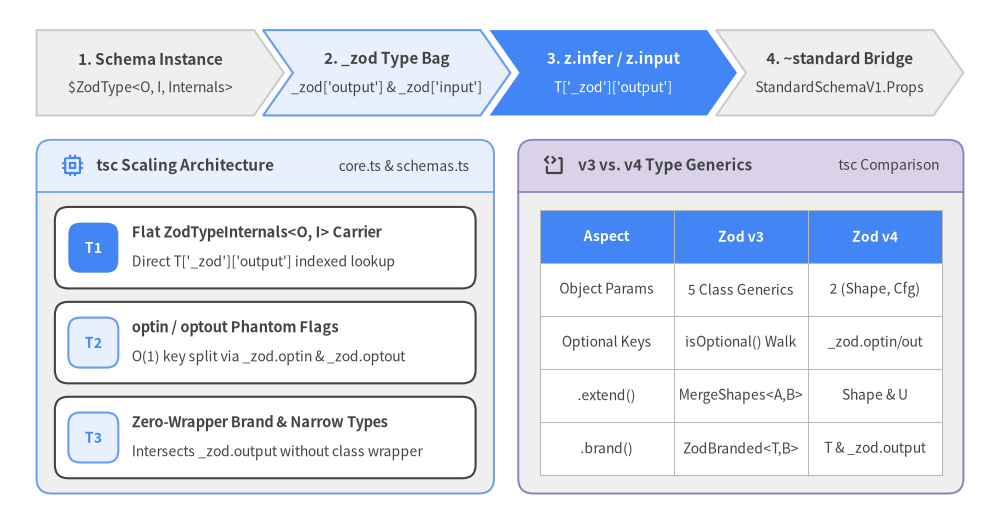
In Zod v3, ZodObject<T, UnknownKeys, Catchall, Output, Input> carried five generic type parameters, where Output = baseObjectOutputType<T> and Input = baseObjectInputType<T> were eagerly computed inside the class signature itself. Every chained .extend(), .merge(), .pick(), or .omit() forced the TypeScript compiler (tsc) to recompute and instantiate those mapped types across every intermediate step, frequently hitting TS2589: Type instantiation is excessively deep and possibly infinite.
Zod v4 eliminates this bottleneck through four foundational type-system designs in packages/zod/src/v4/core/core.ts and packages/zod/src/v4/core/schemas.ts:
1. Flat _zod: $ZodTypeInternals<O, I> Indexed Lookup
Every schema instance in Zod v4 conforms to $ZodType<O, I, Internals>, which stores its static input/output types and metadata inside a single _zod property bag rather than deeply nested class parameters:
// packages/zod/src/v4/core/core.ts
export interface $ZodTypeInternals<out O = unknown, out I = unknown> extends _$ZodTypeInternals {
  output: O;
  input: I;
}

export type input<T> = T extends { _zod: { input: any } } ? T["_zod"]["input"] : unknown;
export type output<T> = T extends { _zod: { output: any } } ? T["_zod"]["output"] : unknown;
export type { output as infer };
Because output<T> (z.infer<T>) and input<T> (z.input<T>) perform a direct indexed property lookup (T["_zod"]["output"]) instead of pattern-matching T extends ZodType<infer O, any, any>, TypeScript caches the property type on _zod directly.
2. Two-Parameter $ZodObject<Shape, Config> and optin / optout Phantom Flags
Instead of computing object output/input types inside class type parameters, $ZodObject<Shape, Config> takes only two parameters (Shape and Config extends $ZodObjectConfig = $strip) and defers mapped-type evaluation to $ZodObjectInternals<Shape, Config>:
// packages/zod/src/v4/core/schemas.ts
type OptionalOutSchema = { _zod: { optout: "optional" } };
type OptionalInSchema = { _zod: { optin: "optional" } };

export type $InferObjectOutput<T extends $ZodLooseShape, Extra extends Record<string, unknown>> =
  string extends keyof T
    ? util.IsAny<T[keyof T]> extends true
      ? Record<string, any>
      : Record<string, never>
    : Identity<
        {
          -readonly [k in keyof T as T[k] extends OptionalOutSchema ? never : k]: T[k]["_zod"]["output"];
        } & {
          -readonly [k in keyof T as T[k] extends OptionalOutSchema ? k : never]?: T[k]["_zod"]["output"];
        } & Extra
      >;
Key tsc optimizations in $InferObjectOutput and $InferObjectInput:
- Empty Shape Fast-Path (
string extends keyof T): Immediately resolvesz.object({})toRecord<string, never>without instantiating mapped key Remapping loops. - Phantom
optin/optoutFlags: Wrappers like$ZodOptional(optin: "optional"; optout: "optional"),$ZodDefault(optin: "optional"; optout?: undefined), and$ZodPrefault(optin: "optional") declare their optionality directly on_zod. Key partitioning checksT[k] extends OptionalOutSchemain $\mathcal{O}(1)$ structural depth without walking wrapper chains. - Flat Intersection via
util.Extend<Shape, U>: Calling.extend(U)computesutil.Extend<Shape, U>(keyof Shape & keyof U extends never ? Shape & U : Omit<Shape, keyof U> & U), using a pure intersectionShape & Uwhenever the added keys are disjoint!
3. Zero-Wrapper Type Intersections ($ZodBranded & $ZodNarrow)
In Zod v3, .brand<"UserId">() returned a new ZodBranded(schema) wrapper class. In Zod v4, .brand() returns the schema untouched at runtime (return this as any) and applies a zero-wrapper intersection at the type level:
// packages/zod/src/v4/core/core.ts
export type $ZodBranded<T extends SomeType, Brand extends string | number | symbol> = T &
  Record<"_zod", Record<"output", output<T> & $brand<Brand>>>;

export type $ZodNarrow<T extends SomeType, Out> = T & Record<"_zod", Record<"output", Out>>;
4. Native Standard Schema v1 (~standard in standard-schema.ts)
Every $ZodType exposes a lazy ~standard getter attached in $ZodType's $constructor (packages/zod/src/v4/core/schemas.ts) that implements both StandardSchemaV1 and StandardJSONSchemaV1:
// packages/zod/src/v4/core/schemas.ts
util.defineLazy(inst, "~standard", () => ({
  validate: (value: unknown) => {
    try {
      const r = safeParse(inst, value);
      return r.success ? { value: r.data } : { issues: r.error?.issues };
    } catch {
      return safeParseAsync(inst, value).then((r) =>
        r.success ? { value: r.data } : { issues: r.error?.issues }
      );
    }
  },
  vendor: "zod",
  version: 1 as const,
}));
Notice how validate(value) executes synchronously via safeParse(inst, value) first and only falls back to safeParseAsync(inst, value) if $ZodAsyncError is thrown by an asynchronous refinement or transform.
6.2 Zero-Allocation Issue Collection, finalizeIssue, and 49+ Locales
In Zod v3, every failed validation constructed a full Error object (triggering V8 stack frame capture) and eagerly formatted localized strings during the parse walk. Zod v4 decouples raw issue collection from error finalization and formatting.
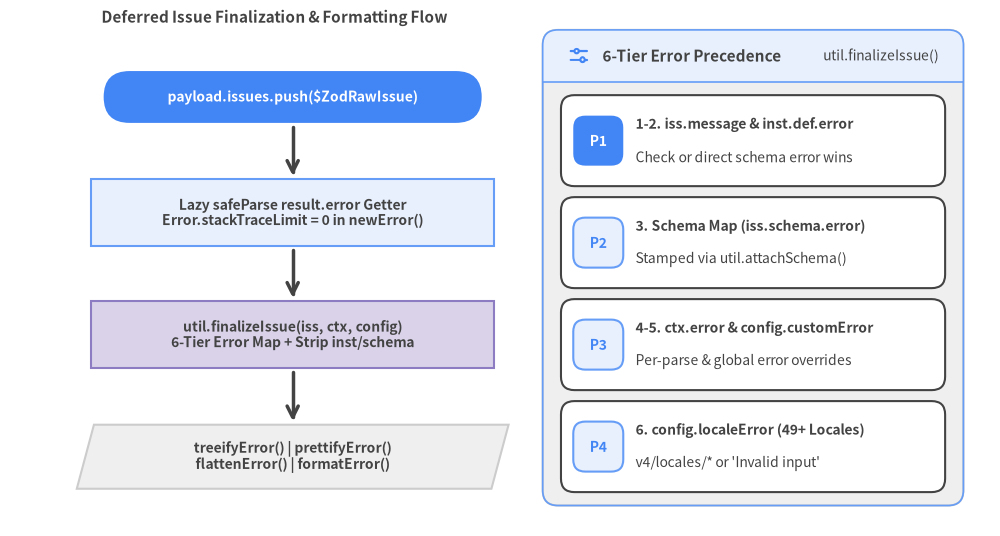
1. Zero-Stack-Capture newError() & Lazy safeParse Error Getter
In V8, calling new Error() walks the execution stack to populate error.stack, which dominates the CPU cost of failed validations. Zod v4 eliminates this overhead on two fronts:
Error.stackTraceLimit = 0innewError(core.ts): WhenZodRealErroris instantiated insidenewError(issues), Zod temporarily setsError.stackTraceLimit = 0aroundnew Definition(issues)and restores the previous limit infinally. Whenparse()(which throws) fails, it captures a clean stack trace starting at the user's call site viaError.captureStackTrace(e, callee).- Lazy
errorGetter onsafeParse()(parse.ts): WhensafeParse()fails, it does not immediately finalize raw issues or instantiateZodError. Instead, it returns an object with a lazyget error()property memoized vialet _err:
// packages/zod/src/v4/core/parse.ts
return result. issues.length
  ? {
      success: false,
      get error() {
        if (this._error) return this._error as any;
        const issues = result.issues.map((iss) => util.finalizeIssue(iss, ctx, core.config()));
        const err = new _Error(issues);
        this._error = err;
        return err;
      },
      _error: undefined,
    }
  : { success: true, data: result.value as any };
If caller code only checks if (!res.success) return null;, finalizeIssue and new _Error() never run at all! Even after ZodError is constructed, err.message (which formats JSON.stringify(err.issues, null, 2)) is itself a lazy getter installed via _messageDesc in packages/zod/src/v4/core/errors.ts.
2. The 6-Tier finalizeIssue() Specificity Waterfall (util.ts)
When result.error is accessed, util.finalizeIssue(iss, ctx, config) (packages/zod/src/v4/core/util.ts) transforms each $ZodRawIssue into an immutable public $ZodIssue:
// packages/zod/src/v4/core/util.ts
export function finalizeIssue(iss: errors.$ZodRawIssue, ctx: ParseContextInternal | undefined, config: $ZodConfig): errors.$ZodIssue {
  const full = { ...iss, path: iss.path ?? [] } as errors.$ZodIssue;
  if (!iss.message) {
    const message =
      unwrapMessage(iss.inst?._zod.def?.error?.(iss as never)) ??
      unwrapMessage(iss.schema?._zod.def?.error?.(iss as never)) ??
      unwrapMessage(ctx?.error?.(iss as never)) ??
      unwrapMessage(config.customError?.(iss as never)) ??
      unwrapMessage(config.localeError?.(iss as never)) ??
      "Invalid input";
    full.message = message;
  }
  delete (full as any).inst;
  delete (full as any).continue;
  delete (full as any).schema;
  delete (full as any).__proto__;
  if (!ctx?.reportInput) {
    delete (full as any).input;
  }
  return full;
}
Notice the subtle distinction between Tier 2 (iss.inst) and Tier 3 (iss.schema):
- When a check (
z.string().min(5, { error: "Check err" })) fails inside a schema (z.string({ error: "Schema err" })),iss.instis the$ZodCheckMinLengthinstance, whereasutil.attachSchema(schema)stamps the owning$ZodStringontoiss.schemainsideschemas.ts! - Consequently, a check-specific error map (
iss.inst._zod.def.error) takes precedence over its parent schema's error map (iss.schema._zod.def.error), which in turn takes precedence over per-parsectx.error, globalconfig.customError, and globalconfig.localeError. - By default,
finalizeIssuedeletesfull.inputto prevent accidentally leaking sensitive user payloads (such as passwords or tokens) into serialized API error logs unlessreportInput: trueis explicitly passed.
3. Tree-Shakeable Locale Architecture (packages/zod/src/v4/locales/)
In packages/zod/src/v4/locales/index.ts, Zod v4 ships 63 exported locale modules covering 49+ languages (ar, az, be, bg, ca, cs, da, de, el, en, eo, es, fa, fi, fr, frCA, he, hi, hr, hu, hy, id, is, it, ja, Georgian/ka, kh, km, ko, lt, mk, ms, nl, no, ota, pl, ps, pt, ru, sl, sr, sv, ta, th, tr, ua, uk, ur, uz, vi, yo, zhCN, zhTW, etc.).
Each locale module exports a zero-dependency factory (export default function (): { localeError: $ZodErrorMap }) constructed around three lightweight helpers:
parsedType(data): Maps runtime JavaScript values into localized type names (e.g.,"number","NaN","array","null", or"数値","配列"inja.ts).NounsDictionary &getSizing(origin): Mapsissue.origin("string","array","set","file"," number","int","bigint","date") to localized unit nouns (unit: "characters",verb: "to have"inen.ts;unit: "文字",verb: "である"inja.ts).- Switch over
issue.code: Dispatches over the consolidated v4 issue taxonomy (invalid_type,invalid_value,too_big,too_small,invalid_format,not_multiple_of,unrecognized_keys,invalid_key,invalid_union,invalid_element,custom).
Because zod/v4/core does not import any locale by default (Classic/Mini entrypoints load en() inside their bootstrap), applications using zod/v4/core or importing a single locale via import ja from "zod/v4/locales/ja.js" pay zero bundle cost for unused languages.
4. Structured Error Formatters (treeifyError, prettifyError, flattenError, formatError)
packages/zod/src/v4/core/errors.ts provides four structured transformations over $ZodError:
treeifyError(err, mapper): Replaces the legacyformat()/flatten()helpers with a uniform recursive tree{ errors: string[], properties?: Record<string, $ZodErrorTree>, items?: ($ZodErrorTree | undefined)[] }that cleanly separates object property paths from array index paths.prettifyError(err): Sorts issues byissue.path.lengthascending, renders each issue with✖ ${issue.message}followed by→ at ${toDotPath(issue.path)}(escaping non-identifier keys as["..."]), and indents nested union sub-errors recursively.- Prototype-Pollution-Hardened
flattenError&formatError: Both legacy formatters explicitly guard path traversal withObject.prototype.hasOwnPropertyandObject.definePropertywhen writing dynamic keys so maliciously crafted input keys like"__proto__"or"constructor"cannot mutateObject.prototype.
← 5. WeakMap Registries & JSON Schema Bidirectional Engine | Architecture Overview →